
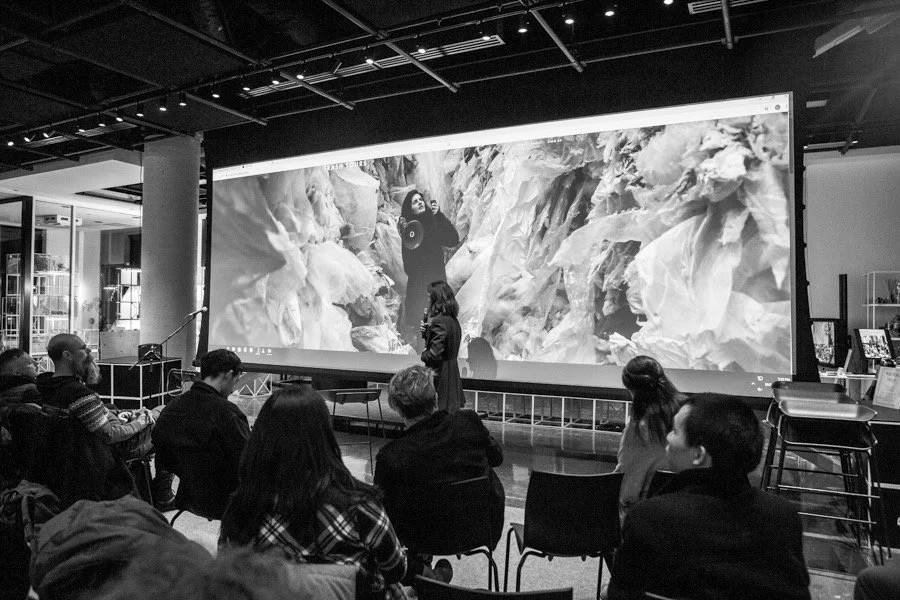
PULSE Talks
Augmented Reality Art in Public Space artist talk with Tamiko Thiel
March 10th 2021, 10am-12pm EST, online webinar
PULSE co-hosts with the research group CINEMAexpo67, directed by Dr Monika Kin Gagnon, Concordia Department of Communications
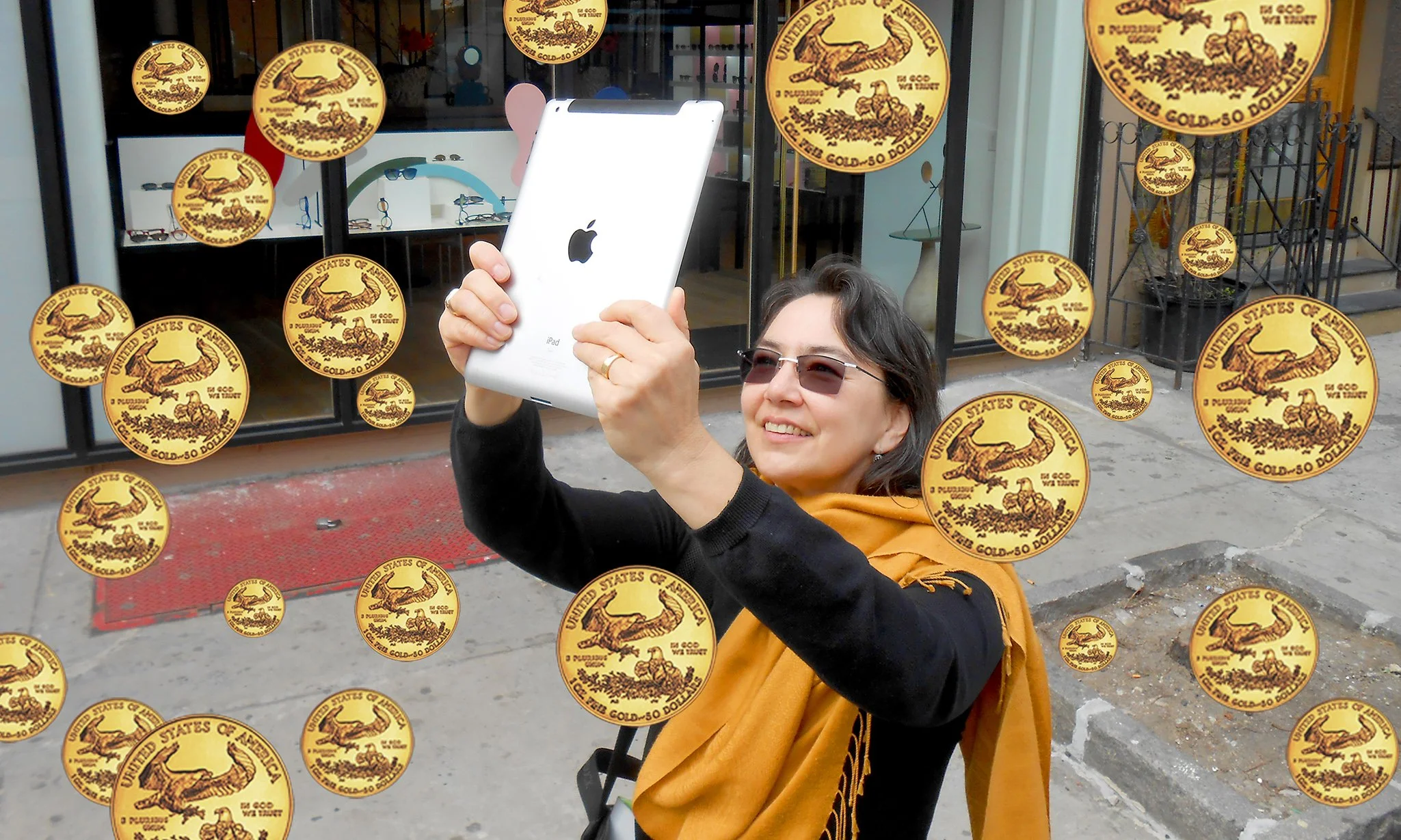
"Reign of Gold" AR installation, for AR Occupy Wall Street Project. Tamiko Thiel © 2011
Who gets to tell the stories? Who is allowed to define, memorialize and occupy public space? Physical urban monuments and the histories they tell - even if just a tiny, barely visible plaque - are subject to lengthy and costly submissions to city authorities. Humans have been augmenting public space since time immemorial, from the very first time one person told a story to another about a particular place. Augmented reality frees public space - and visible parts of private space - to anyone determined to get their story heard. Tamiko will show examples of her own AR artworks as well as from other urban AR artists to reclaim public space for a larger, more inclusive public.
Tamiko Thiel was awarded the 2018 Visionary Pioneer Award by the Society for Art and Technology Montreal for her (now over 35) years of media artworks exploring the interplay of place, space, the body and cultural identity in political and socially critical artworks. She was lead product designer on the "Connection Machine CM1/CM2“ AI supercomputer, in 1989 the fastest computer on earth, now in the collection of MoMA NY. She began working with virtual reality in 1994 as producer and creative director of "Starbright World" (1994-‘97), the first online 3D virtual world for children, in collaboration with Steven Spielberg. Her first VR art installation "Beyond Manzanar" (2000) is in the collection of the San Jose Museum of Art, and her work as GoogleVR Tilt Brush artist in residence, Land of Cloud (2017), won the 2018 VRHAM VR Festival Hamburg Audience Award.
She began working with augmented reality (AR) in 2010, showing her AR installation “ARt Critic Face Matrix” as part of a path-breaking AR intervention into MoMA NY. In 2011 she curated and organized an AR intervention into the 2011 Venice Biennial for her artists group Manifest.AR, including her own work “Shades of Absence.” Her AR commissions since then include “Unexpected Growth” for the Whitney Museum NY, where it is now in the permanent collection.
Many of her AR installations have been urban interventions into the public sphere and address issues such as pollution in the hidden river running through an expensive part of Brooklyn in “Newtown Creek (oil spill)” (2011), to meditating on the past, present and future of a Munich neighborhood in “Transformation: Lehel“ (2012), to covering downtown Liverpool, UK with wild growth in “Biomer Skelters“ (2013), and mapping the history of four generations of her Japanese American family in a city-wide project in Seattle with “Brush the Sky” (2015). Tamiko is an AR artistic advisor on numerous projects that map histories of minority communities including the Rockefeller Foundation grant for the Caribbean Cultural Center and African Diaspora Institute to create “Mi Querido Barrio“ (2016) in the East Harlem neighborhood of Manhattan, and more recently on the Hidden Histories of San Jose Japantown project in San Jose, California.
The Blue Hour VR with Paul Cegys
artist talk on digital scenography
January 20th, 16-18h @4th Space Concordia
1400 de Maisonneuve Blvd. W.
This event is wheelchair accessible.
The Blue Hour VR experience, created by Paul Cegys and Joris Weijdom, as part of the 36Qº at the 2019 Prague Quadrennial of Performance Design and Space, is an innovative and formative example of a site-responsive mixed reality (MR) performance design, which blurs the boundaries between performance, spectatorship, and real and virtual environments. Piloting interactive virtual-reality (VR) technology and hybrid environments that blend 360º cinematography and real-time 3D graphics, Blue Hour VR drew new lines of experience for participants, placing them at the centre of a performance experience, thereby expanding our understanding of scenographic dramaturgies that exist inside, outside and in-between realities. Its artistic impetus was rooted in a social one, asking what it means to be ‘present’ in relationship to different shifting ecological spaces and the consequences of the anthropocene.
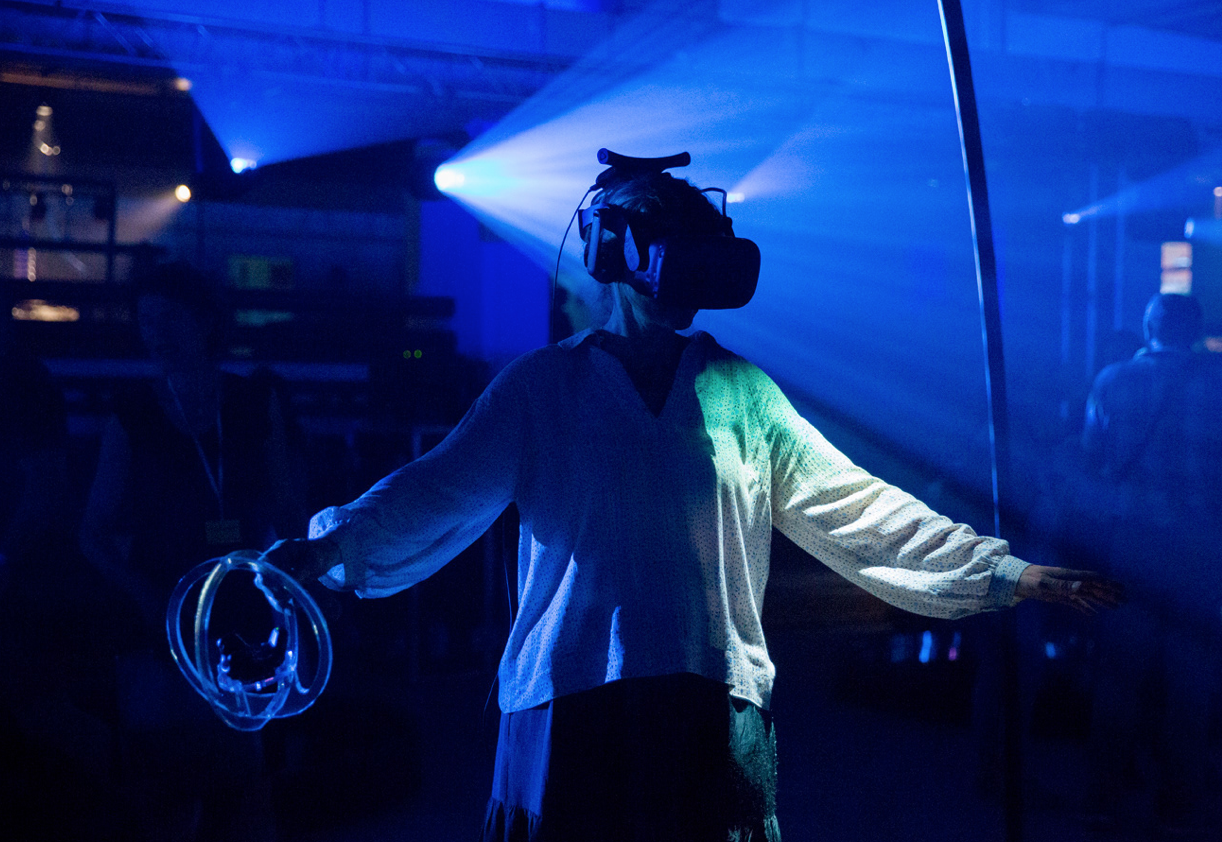
Photo credit: Tomáš Brabec, Jan Hromadko, David Kumermann
Blue Hour VR experience explicitly focused on the interweave between different modes of sensing within the experiencer’s physical body through the blending of real and virtual environments. This radically (re)positioned the body of the experiencer at the locus of performance, duplicating her in two places at the same time (real and virtual), thereby (dis)connecting and (re)mediating social relationships. In doing so the mixed-reality performance design of the Blue Hour VR experience questions the very ontology of performance.
Paul Cegys’ work merges multiple practices of performance creation and design, from theatre and opera to site-specific installation and intermedial mixed-reality scenographies. He has worked abroad in Italy, Finland, Czech Republic, India, Sweden, Denmark, Belgium, Poland, Lithuania, and the United States. He has worked for La Monnaie/De Munt (Royal Belgian Opera), Canadian Opera Company, CanStage, Soulpepper Theatre Company, and Opera Hamilton. Upholding his commitment to ecological imperatives he merges his artistic work with his sustainability practice (MSc. in Sustainability Science and Environmental Studies, Lunds University, Sweden). Cegys is the Co-Creator of Blue Hour VR, a site-responsive mixed-reality performance event which premiered at the 2019 Prague Quadrennial of Performance Design. He is the Co-Creator of Individuality and Interconnection, a 360º video project that maps the creative spaces of Canadian performance designers and he is the Digital Scenographer for The Home, a VR experience designed for the Digital Oral Histories for Reconciliation project funded by SSHRC and in partnership with Oculus VR. He is a Lecturer in the Department of Communication Arts at the University of Waterloo, and serves on the advisory board of the Toasterlab Mixed Reality Performance Atelier. He is currently a PhD candidate at the School of Arts, Design and Architecture at Aalto University in Finland.
Infiltrating Smartness:
Performative Urbanism and the Smart City
Since 2019 PULSE researchers have been engaging with current social, political, and artistic situations pertaining to smart cities. Led by Professor Shauna Janssen, PULSE researchers Allison Peacock, christian scott, Katrina Jurjans, and Eduardo Perez - presented their work and critical engagements with current variations of sentience and smartness that infiltrate experiences of urbanism as part of the Uncommon Senses III: Back to the Future of the Senses online Conference, hosted by Concordia University's Centre for Sensory Studies, May 6—9 2021.
Scenographic City
January 14th, 9h00-12h00 EST, Register here
This international event discusses examples of urban scenography and considers scenographic strategies as part of urban research and futures.
The event is organized by Dr Joslin McKinney, Associate Professor in Scenography and Programme Leader for the MA in Performance Design at the University of Leeds, UK.
Speakers:
Marina Hadjilouca (Cyprus + UK) Scenographic tactics in contested public spaces
Dorita Hannah (Aotearoa/New Zealand) Navigating urban scenographies of the ‘real’
Shauna Janssen (Turtle Island/ Canada) Urban Scenographics: Towards Partial Perspectives, Situated Practices, and Unsettling Existing Perceptions of Place
Joslin McKinney (UK) Understanding urban space as scenography
Respondent: Rachel Hann (UK)
Contemporary scenography, no longer confined to theatre stages, is now being used to interrogate and transform urban space. The 'place-orientating methods of scenography shape other social and art practices' (Hann 2019: 5) and it 'provides a critical tool to reflect, confront and realign worldviews' (Hannah and Harslof, 2008:19). Scenography can be 'a device for critically reflecting...intervening, defamiliarizing and re-orienting experiences of hegemonic spatial politics on an urban scale (Janssen 2019:208). Now, following prolonged periods of lockdown, the need to understand the diversity of urban experience and the ways in which people feel themselves to belong in the city seem more urgent than ever. Might the affective, creative and imaginative dimensions of our lives that scenography deals with provide new ways of thinking about the 'spatial politics of urban change' (Janssen 2019:208)?
This international seminar will consider examples of recent practice and ask:
• what characterises a scenographic approach to the urban and to placemaking?
• what can distinctively scenographic perspectives on urban experience reveal?
• how do scenographic techniques facilitate change and transformation of the urban?
Abstracts and Biographies
Dr Rachel Hann is Senior Lecturer in Performance and Design at Northumbria University, Newcastle. Her research is focused on the material cultures of scenography, costume and architecture. She is author of Beyond Scenography (Routledge 2019), which was shortlisted for the Prague Quadrennial 2019 Publication Prize. In 2013, Rachel co-founded the research network Critical Costume and in 2014 co-edited a special issue of Scene (Intellect) on costume.
Marina Hadjilouca - Scenographic tactics in contested public spaces
In this presentation Marina Hadjilouca will present an open-source toolkit for scenographic interventions. This toolkit aims to explore site-specificity and social change through small triggering acts of multiplicities in the contested urban site. The toolkit can be used as a tangible instrument by performance designers, artists and architects who engage with urban sites in a critical way. Drawing from a series of interventions and workshops that took place in Cyprus and the UK, Marina discusses the political potential of performance design when taken into the contested urban milieu, outside the theatrical confines. Through these examples, she argues that performance design when informed by processes of social art practice and conceptual frameworks built on cultural geography, can be used as a methodological tool towards social transformation. Dr Marina Hadjilouca is a performance designer and an academic, currently based at Rose Bruford College. As a researcher Marina focuses on the use of performance design as a methodology for politicised practices. Marina's research interests lie in the synergies between social art practice and performance design. She has presented her research in conferences and symposiums in Europe and the UK and has published papers in conference proceedings. Marina is one of the organisers of the Socially Engaged Design (SED) Conference in Cyprus. As a practitioner, Marina creates scenographic interventions in contested public spaces and designs sets and costumes for theatrical performances.
Dorita Hannah - Navigating urban scenographies of the ‘real’
For many reasons – including the ongoing pandemic – theatre has left the ‘dead air’ of its designated buildings, seeking ‘the real’ in all its manifestations, which radically shifts modes of spectatorship, performance and therefore scenography. The city itself, historically rooted in scenographic practice, is an increasingly performative environment: entwining the virtual and the material, while disciplining civic bodies with security fencing, stanchion barriers, fluoro-orange traffic cones and proliferating signage; all designed to regulate our individual and collective movement. This tends to limit our engagement with the urban environment, curtailing spontaneous self-expression while disregarding the city’s multiple histories, cultural mythologies, and socio-political realities. However, the highly mediatized global stage we occupy reveals a hyper-theatricalization of everyday life, blurring the boundaries between fact and fiction. Presenting a range of key urban performance projects, including her own collaborative dance-architecture events, Dorita Hannah considers how challenging well-established binaries – between mythos and materiality, safety and danger, theatre and city – can inform how urban environments are developed and experienced, especially the Pasifika | Moana Nui City of Oceania. Dr Dorita Hannah is a designer and independent academic whose practice and research – operating across the architectural, performing, culinary and visual arts – focus on performance space and spatial performativity. Her international projects range from theatre architecture (space-in-action) to public events (action-in-space), addressing the dynamics, politics and intermediality of the public realm. Hannah has published on Performance Design and Event-Space, while designing, curating and directing exhibitions, installations, performances, feasts, symposia and workshops. Her creative work has gained awards and citations and has been regularly selected for exhibition in World Stage Design and the Prague Quadrennial of Performance Design & Space.
Dr Shauna Janssen - Urban Scenographics: Towards Partial Perspectives, Situated Practices, and Unsettling Existing Perceptions of Place
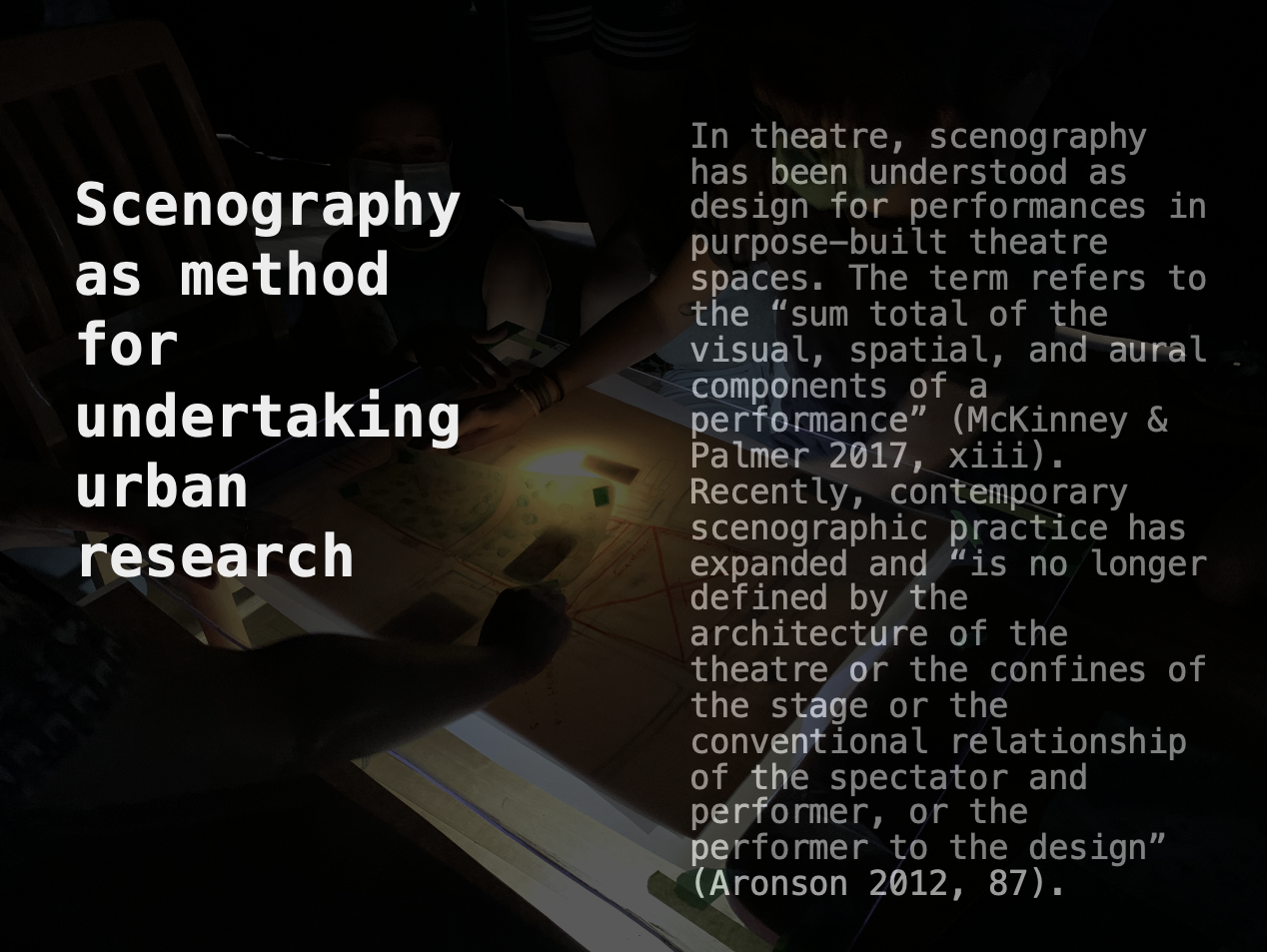
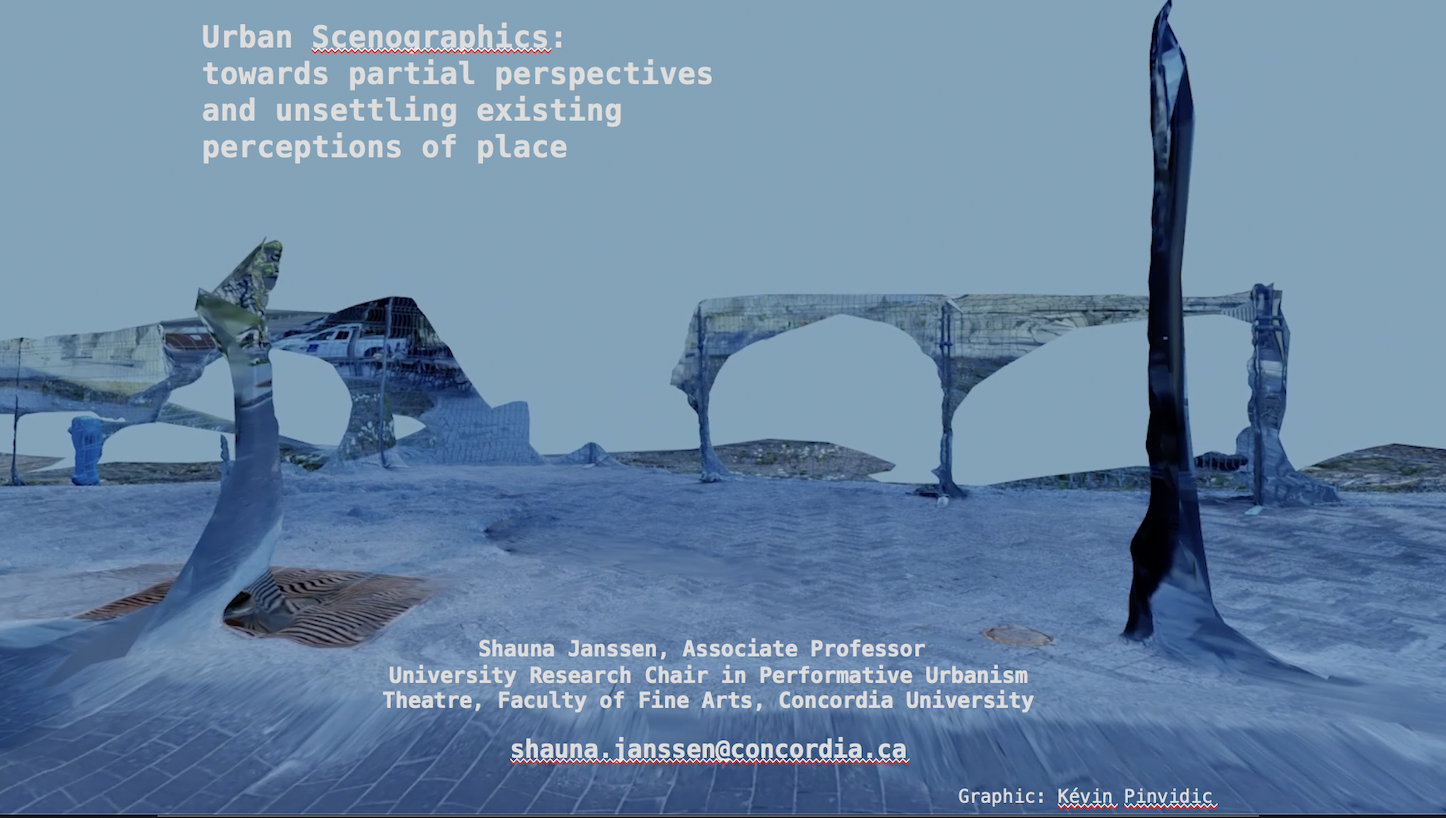
In this presentation Shauna Janssen foregrounds scenographic practice as method for urban research, community-engagement, and critical place making, with a strong redressive critique of ‘urban revitalization’. Drawing from her curatorial work and the site-specific ARCADE project, she explores the critical capacity that scenographic practices have to disperse, reframe and situate theatre architectures across multiple scales and experiences of the material, spatial, sociohistorical, political and cultural resonances and affects that are felt by, through and with urban change.Dr Shauna Janssen lives and works in Tiohtià:ke/ Montréal, Turtle Island/ Canada. She is an Assistant Professor of Performance Creation at Concordia University, where she holds a University Research Chair in Performative Urbanism. She directs PULSE, an interdisciplinary research-creation lab which focuses on site responsive, urban, spatial and material practices that redress and engage with themes of spatial justice and the politics of urban change. Her curatorial projects and performance design practice engages with interdisciplinary, feminist and scenographic methods to engage with questions of the right to the city. She has published numerous essays and monographs on site-specific art, public space, performance pedagogy, and performative practices including with the International Journal of Performance & Theatre Design, FIELD: a Journal of Socially-Engaged Art Criticism, and PARtake: the Journal of Performance as Research.
Dr Joslin McKinney - Understanding urban space as scenography
The effects of urban spaces on individuals can have profound effects on a sense of identity and belonging yet they often go unnoticed and unexplored. In this presentation Joslin McKinney investigates how we might attune ourselves to the spatial and sensory qualities of the city and the effects that they might be having on us. It draws on workshops in which participants pay special attention to the scenographic qualities of urban space and it considers how attunement to the scenographic offers new perspectives on ‘the complex materialities of the urban’ (McCormack and Latham 2004). It is proposed that creative, participatory methods developed in scenography could contribute to investigations into subjective urban experience and that scenographic attunement might be valuable as part of efforts to resist dominant narratives of neo-liberal urban space and construct alternative subjectivities. Dr Joslin McKinney is Associate Professor in Scenography and Programme Leader for the MA in Performance Design at the University of Leeds, UK. She is the lead author of the Cambridge Introduction to Scenography (CUP 2009) and co-editor of Scenography Expanded: an Introduction to Contemporary Performance Design (Bloomsbury 2017). She has published articles and chapters on scenographic research methods, scenographic spectacle and embodied spectatorship, phenomenology, kinaesthetic empathy and material agency. She is co-editor of the Performance + Design book series for Bloomsbury that reflects the recent growth of scenographic practices and the expansion from theatre/stage design to a wider notion of scenography as a spatial practice. Her current research is concerned with using scenography to understand the experience of urban space.
Urban Scenographics:
towards partial perspectives & unsettling existing perspectives of place
invited talk for
symposium-international-de-lomec-cohabiter-imaginer-les-mediations-culturelle
au-21e-siecle-les-1-2-3-juin/
Performing Grounds: unsettling cultural landscapes
Performing Grounds: Unsettling Cultural Landscapes was an online gathering that invites thinkers, designers and artists from Aotearoa New Zealand, Australia, the Pacific (Moana Nui a Kiwa) and Turtle Island (Canada) to share their indigenous knowledges and reparative approaches to unsettling and reconfiguring grounds for performing identities, technologies and stories.
Latai Taumoepeau, Amanda Yates, Shannon Foster & Jo Kinniburgh (Bangawarra), Tanya Lukin Linklater, and Tiffany Shaw Collinge.
The event was hosted by PULSE in association with IFTR’s Theatre & Architecture Working Group as part of the 4th Space Residency program, Concordia University, Tiohtià:ke/ Montreal.
Performing and performance space generally involves an event of ‘taking place’… but where, what, and whose place? What does it mean to design and construct performance space in a precarious world pushed to its limit by climate catastrophe, mass migration and unruly pandemics that threaten established borders and the territories they contain?
It seems more urgent than ever to critically reconsider the necessary and entangled relationship between space and performance, between site and action, between theatre as built form and theatre as art form. Architecture continues to serve the Western knowledge systems responsible for the conditions that dominate our cultural landscapes; evidenced by a proliferation of cookie-cutter auditoria reinforcing colonial legacies, binary thinking and neoliberal capitalism. Performers and audience remain separated within the dead air of theatre as a disciplinary machine, while the very lands these venues occupy – transformed from earth into property – reinforce the narratives of discovery, conquest and occupation. However, within indigenous epistemologies lies the possibility to rethink our relationship to the cultural landscapes we share, as well as how we gather, exchange, and perform diverse cultures.
Performing Grounds: Unsettling Cultural Landscapes is an online gathering that invites thinkers, designers and artists from Aotearoa New Zealand, Australia, the Pacific (Moana Nui a Kiwa) and Turtle Island (Canada) to share their indigenous knowledges and reparative approaches to unsettling and reconfiguring grounds for performing identities, technologies and stories. The event was hosted by PULSE in association with the IFTR Theatre & Architecture Working Group as part of the 4th Space Residency program, Concordia University, Tiohtià:ke/ Montreal.
Un espace de performance implique habituellement un événement qui « prend place »… mais où, quoi et la place de qui ? Qu’est-ce que ça veut dire de concevoir et de construire un espace de performance dans un monde précaire poussé à bout par les catastrophes climatiques, la migration massive et les pandémies incontrôlées qui menacent les frontières établies et les territoires qu’elles contiennent ?
Il semble plus urgent que jamais de reconsidérer d’un œil critique la relation essentielle et enchevêtrée entre l’espace et la performance, entre le site et l’action, entre la forme construite et la forme artistique du théâtre. L’architecture continue de servir les systèmes de connaissances occidentaux responsables des conditions qui dominent le paysage culturel, à preuve, la prolifération d’auditoriums identiques qui renforcent l’héritage colonial, la pensée binaire et le capitalisme néolibéral. Les interprètes et le public restent séparés dans l’air stagnant du théâtre, machine disciplinaire, alors que les terres mêmes qu’occupent ces lieux, transformées de terre en propriété, renforcent les récits de découverte, de conquête et d’occupation. Il existe cependant dans les épistémologies autochtones la possibilité de repenser notre relation avec les paysages culturels que nous partageons ainsi que la façon dont nous rassemblons, échangeons et présentons des cultures variées.
Performing Grounds: Unsettling Cultural Landscapes est une rencontre virtuelle qui invite des penseurs et penseuses, concepteurs et conceptrices et artistes de Aotearoa Nouvelle-Zélande, d’Australie, du Pacifique (Moana Nui a Kiwa) et de l’île de la Tortue (Canada) à partager leur savoir autochtone et leurs approches réparatrices pour décoloniser et reconfigurer le terrain pour la présentation d’identités, de technologies et d’histoires. L’événement etait présenté par PULSE en association avec le groupe de travail Théâtre et architecture de l’IFTR dans le cadre du programme de Résidence Espace 4 de l’Université Concordia, Tiohtià:ke/Montréal.